
Private video hosting
Video assets have no public access by default. Nothing is exposed without explicit configuration.

Host secure videos and control how they are accessed, embedded, and delivered across applications using scalable private video hosting infrastructure.
Access policies live in the storage and delivery layer, so a leaked link stops working the moment you expire it.
You worked hard to keep your content behind a login. A public video URL undoes that in one share.
Public URLs allow uncontrolled viewing and redistribution. Once a direct link exists, there is no revocation mechanism
Without delivery-layer restrictions, hosted video can be embedded on any domain — including unauthorized ones
Sensitive media workflows require authentication-aware delivery that maps to your application's own permission layer
Rabata enables secure video hosting workflows using storage-level permissions and API-based delivery authorization.
Rabata supports secure video delivery workflows using authentication-aware storage access policies designed to limit unauthorized viewing and redistribution.
Signed credentials with configurable expiry ensure video is never accessible beyond the intended session. Revoke access instantly without touching the asset
Delivery-layer domain policies prevent your video from being embedded outside approved environments — enforced at the CDN level, not the player
Policies apply per individual video, not per account or folder. Granular control directly via API
Access policies ensure video assets remain available only to authorized applications and viewers.
Video assets have no public access by default. Nothing is exposed without explicit configuration.

Generate signed URLs with configurable expiry for time-limited secure video playback. Revoke access instantly by expiring credentials.

Control where hosted video can be embedded using delivery-layer policies. Unauthorized embedding is blocked at the CDN level.
Integrate authentication-aware delivery policies directly into your application using a clean REST API with API keys and JWT authentication. Full API access included on every plan.
Video assets stored with encryption at rest. Protected at the storage layer before delivery access policies are applied.
Define access policies per asset, per project, or per domain. Restrict playback to authenticated users or approved environments.



Three steps from upload to protected playback, with every access rule defined through the API.
Store media securely inside Rabata's protected S3-compatible object storage. Uploads use pre-signed URLs, so files go straight to storage without passing through intermediate servers.
Define authentication rules via API: signed URL expiry, domain restrictions, token-based access. Policies are applied at the infrastructure layer — not managed by a third-party platform.
Serve video securely across authorized applications and environments. Delivered via global CDN — consistent secure video streaming performance regardless of viewer location.
Serve protected video assets inside authenticated dashboards, portals, and product environments.

Restrict viewing access across organizational systems. Content stays visible only to authorized team members.
Control delivery of proprietary video assets across approved platforms and environments.
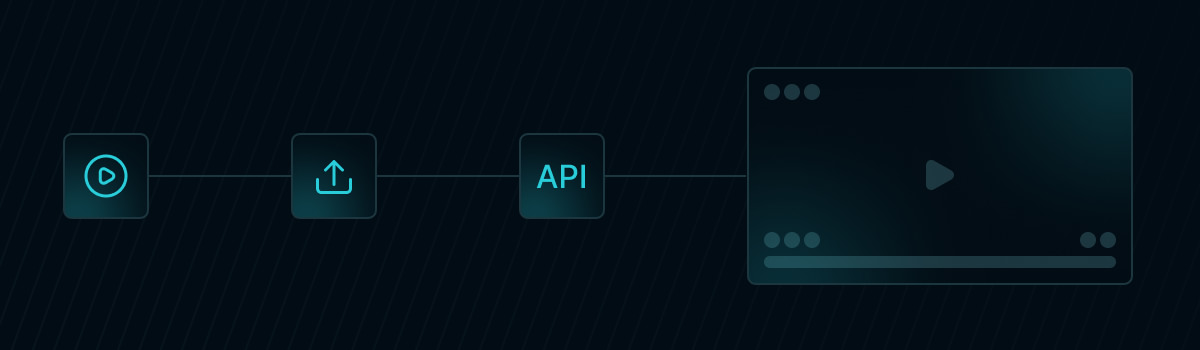
Integrate access-controlled media delivery into custom applications using API-driven workflows.

Video upload (REST API — pre-signed URLs)
Protected object storage (Rabata S3 — private by default)
Access control policies (signed URLs / token auth / domain restrictions)
Authorized delivery endpoints (global CDN)
Web applications / private portals / authenticated delivery environments
Most public video platforms (e.g. Vimeo) are built for distribution — access control is limited to player-level settings that don't enforce restrictions at the infrastructure layer.
|
Feature
|
Rabata
|
Public hosting platforms
|
|---|---|---|
| Default access | Private — no public URLs | Public by default |
| Delivery control | Signed URLs + token auth per asset | Player-level only |
| Embed enforcement | Domain-level CDN restrictions | Open or manually restricted |
| API access | Included on every plan | Requires plan upgrade |
| Pricing model | Usage-only (storage + delivery), no per-seat fees | Per seat or feature tier |
Player settings can be bypassed by anyone who finds the file URL. Storage and CDN policies cannot — they decide whether the bytes are served at all.
Pay for source storage and delivered minutes. Standard on-demand transcoding, full API access, and every access-control feature above are included — not billed separately.
Standard JIT renditions are created when viewers request them.
Infrastructure-level storage and delivery where access to video assets is controlled at the storage and CDN layer — not just at the player. Video is private by default, delivered only to authorized viewers via signed URLs, and never exposed through permanent public links.
Yes. Signed URLs, token-based authentication, and domain-level restrictions are applied per asset via API. Access can be revoked instantly by expiring credentials. No direct file URLs are ever exposed.
Rabata's REST API uses API keys and JWT authentication. Define access policies programmatically — signed URL generation, token auth, domain restrictions, and expiry rules. Full API access included, with no feature gates.
Storage is billed by GB-month, delivery by the minute and resolution — two line items, with all access-control features (signed URLs, domain restrictions, token auth) included at no extra charge. No per-seat fees, no security add-ons.
Rabata stores video in S3-compatible object storage with no public access by default. Playback is delivered via signed URLs with configurable expiry. You control exactly who can access each asset — by authentication token or domain.
Yes. Every asset can be served via signed URL with configurable expiry — from minutes to days. Generated via API, included with no tier restrictions.
Yes. Private SaaS media delivery, internal knowledge platforms, and licensed content distribution are primary use cases. Storage and delivery scale automatically with usage.
Yes. Uploads use pre-signed URLs — files go directly to Rabata S3 storage without passing through intermediate servers. The upload endpoint is authenticated via API key.
