
Embed scalable video hosting
into your application
Store, manage, and deliver product videos directly inside dashboards, portals, and user interfaces using API-driven video infrastructure.
- Built for application-level embedding
- S3-compatible storage backend
- Global delivery infrastructure included
- $20 in credits to start, no credit card required
Support onboarding, tutorials, feature walkthroughs, and documentation video workflows without building custom delivery pipelines.
Designed for modern product and SaaS architectures
Built for developers — API-first, no UI-only workflows, no feature gates, no plan upgrades to unlock core functionality.
Used by teams building:
- SaaS dashboards and admin portals
- Customer portals
- Documentation platforms
- Developer tools
- Knowledge-base systems
Why application video delivery requires infrastructure-level hosting
Modern software products rely on video to guide users through onboarding, feature adoption, documentation, and customer education workflows.
Scaling documentation libraries
Product video collections grow quickly as platforms expand tutorials and support content. Storage that handles individual files is not the same as one built for structured video delivery at scale
Playback reliability across environments
Users expect consistent playback inside dashboards and portals worldwide. A broken embed inside your product reflects on your product
Authenticated access requirements
Product videos often must remain restricted to logged-in users. Public CDN delivery is not sufficient where content access needs to match application-level permissions
Most teams end up stitching together storage, encoding, access control, and playback across multiple systems. With Rabata, video delivery runs inside your product — not alongside it.
Video delivery across the entire product experience
Video isn't a feature — it's part of the product experience. It supports every stage — from first demo to long-term retention.
- Feature walkthrough videos
- User onboarding sequences — reduce time-to-value and cut support ticket volume
- Knowledge-base tutorials
- Help-center video libraries
- API documentation walkthroughs
- Release update explainers
From upload to embedded playback — manageable via a single API integration.
Integrate video hosting directly into application logic
- Programmatic video uploads
- Structured metadata control
- Webhook-triggered workflows
- Playback tokenization
- Delivery policy management
Rabata integrates directly into application backends using API-driven storage and delivery workflows — no separate video infrastructure to manage.
Core infrastructure features for application video delivery
Embed-ready playback delivery
Serve video directly inside dashboards and interfaces via iframe or HLS. Production-ready Vidstack player included — no external platform dependency, no third-party branding. No context switching — video stays inside your product.

S3-compatible storage and asset management
Organise video assets in buckets using standard S3-compatible APIs. Attach metadata at upload, update via API, and query assets programmatically.
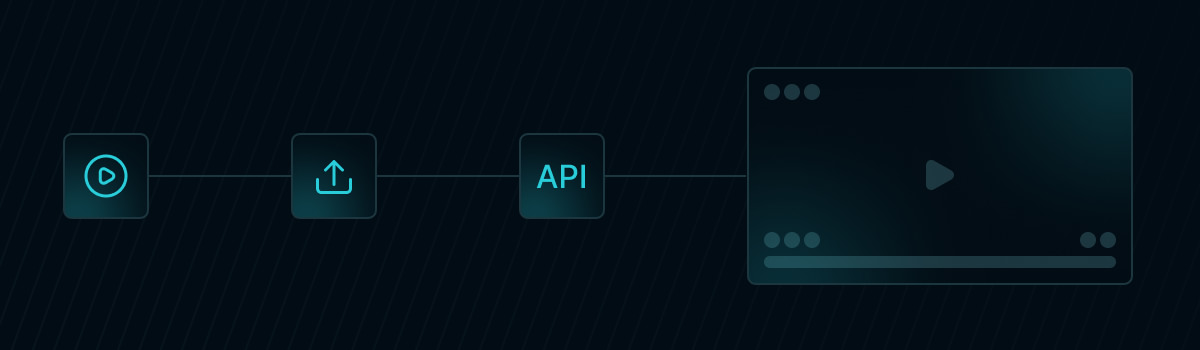
Application-level authentication
Control playback access inside user sessions using signed URLs with configurable expiry, token-based authentication, and domain-level restrictions.
API-driven video workflows
Automate upload, metadata management, transcoding, and playback using a clean REST API. Webhooks trigger downstream application logic when assets are ready. Full API access included, with no tier restrictions.

JIT transcoding — zero queue
Video is transcoded on first request using Just-In-Time processing. No rendering queues, no pre-transcode step. Upload and embed immediately — playback is ready within minutes.
Global delivery infrastructure
Video is served through a global CDN, ensuring consistent playback performance across distributed user bases.
Typical embedded video delivery architecture
-
Upload product videos (REST API or dashboard)
-
S3-compatible storage
-
JIT transcoding on first request
-
Access-controlled delivery layer (signed URLs + token auth)
-
Global CDN delivery
-
Playback inside application interfaces (dashboards / portals / documentation systems / support centers)
Embedded infrastructure vs external video platforms
Most video tools are built for publishing. Applications need video that works inside their backend and user flows. Here's how the approaches differ:
|
Feature
|
Rabata
|
Marketing video platforms
|
General video platforms
|
|---|---|---|---|
| Pricing model | Usage-only (storage + delivery) | Per seat + feature tiers | Per seat |
| API access | Full API on every plan | Requires expensive plan upgrade | Limited by tier |
| Application embedding | Full backend control | Limited customisation | Embed-only |
| Authenticated playback | Signed URLs + token auth per asset | Platform-managed | Player-level only |
| Storage architecture | S3-compatible — no vendor lock-in | Closed ecosystem | Flat library |
| Workflow automation | REST API + webhooks, fully programmable | UI-based | UI-based |
| Platform dependency | No external platform dependency | Platform-hosted | External system required |
| User experience | No context switching — video stays inside product flows | Redirects or overlays | External player experience |
| Scales with product growth | Predictable — cost scales with usage | Grows with team size and feature usage | Grows with seats and bandwidth |
If you just need a player on a page, most tools will work. If video lives inside your product — you need infrastructure.
Predictable pricing for application video delivery
Pay for source storage and delivered minutes. Full API access, team members, standard transcoding, and webhooks are included — not billed separately. No per-seat fees.
Standard JIT renditions are created when viewers request them.
Frequently asked questions about video hosting for applications
Infrastructure-level video storage, transcoding, and delivery built into your product — not linked from an external platform. Upload via API, control access per asset, embed playback directly inside your interface.
Yes. REST API, webhooks, and programmatic asset management are included, with no tier restrictions.
Yes. Every asset has no public access by default. You control exactly who receives a valid playback link — gate content behind authentication, subscription status, or any application-level condition via API.
There's no fixed monthly plan. Source storage is $0.006 per GB-month. Delivery starts at $0.60 per 1,000 delivered minutes and varies by resolution (up to 4K). Standard on-demand transcoding is included at no extra charge. Full breakdown in the billing documentation.
Every uploaded asset gets a playback URL and embed code automatically. Use the included Vidstack player via iframe or pass HLS URLs into your own player.
Yes. Signed URLs, token-based authentication, and domain-level restrictions are included on all plans. Video assets have no public access by default.
Yes. Onboarding videos reduce time-to-value and cut support ticket volume — but only when they load reliably inside your product. Rabata handles storage, transcoding, and delivery so your team focuses on the content, not the pipeline.
Storage and delivery scale automatically with usage — no commitment, no seat limits. Get started free and scale when you need to.
