
Scalable video hosting
for AI & GenAI startups
Store AI-generated videos in scalable S3-compatible object storage built for rapidly growing generative media workloads.
- Built for large AI-generated video files
- Storage and delivery on one API
- JIT transcoding included
- $20 in credits to start, no credit card required
Keep generated video outputs outside your application servers, automate storage through standard S3 workflows, and scale your media library independently from your AI inference infrastructure.
Video infrastructure for AI-native products
- Text-to-video applications
- AI avatar platforms
- Generative advertising tools
- Personalized video applications
- AI creative platforms
- Generative media SaaS products
AI video generation outgrows storage and delivery fast
Generating the video is only one part of the workflow. Every completed generation creates a large media asset that must be stored, organized, retrieved, and connected back to the application.
Generated video libraries grow fast
Each user request can generate multiple outputs, variations, retries, or regenerated versions, causing storage requirements to grow much faster than traditional media libraries.

Video outputs are large
Generated video files require significantly more storage capacity than text outputs and often much more than generated images.
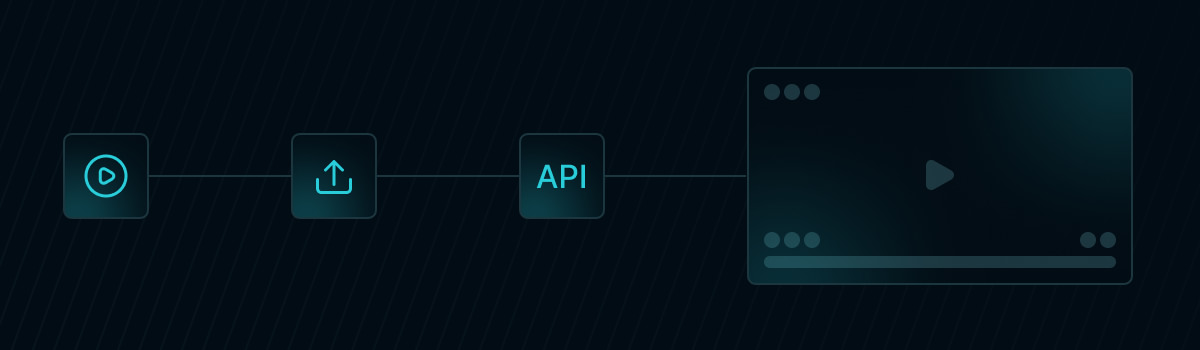
Application servers should not become media storage
Keeping generated video files on application servers ties media growth to compute infrastructure and makes scaling more expensive and difficult.
Generated assets may be private
AI-generated video often belongs to a specific user, workspace, project, or customer and should not automatically become publicly accessible.

Core features for hosting AI-generated video
JIT transcoding, on delivery
Generated video is transcoded on first playback request and delivered as an adaptive stream — billed only for what's actually delivered, not for every file you store.
S3-compatible video storage
Upload generated video directly from your AI pipeline via a standard S3-compatible API — no proprietary integration to build.
Organized video libraries
Organize generated video by user, generation job, workspace, or project, and retrieve it through your application whenever it's needed.
Private video by default
Generated video sits in private buckets, with IAM permissions managing which applications and services can reach it.
Signed access for viewers
Grant temporary, presigned access to a specific video without making it permanently public.
Multipart uploads for large files
Upload large generated video files efficiently and reliably, without timeouts or retries.
Video scales independently of your app
A traffic spike in views becomes a delivery cost, not an application capacity problem.
EU and US delivery regions
Store and deliver video from eu-west-2 or us-east-1, supporting GDPR data residency for European teams.
Predictable pricing for AI-generated video storage and delivery
Pay for source storage and delivered minutes. Standard on-demand transcoding is included. No fixed plan.
Standard JIT renditions are created when viewers request them.
Also storing training data, not just generated video?
Datasets, embeddings, and model checkpoints run on the same S3-compatible infrastructure, at the same storage rate.
Typical AI-generated video storage and delivery architecture
Swap generation providers, self-host a model, or run several at once — Rabata doesn't need to know which one produced the file. Commercial APIs, self-hosted models, custom pipelines, GPU inference setups: if it outputs a video file, it can land in the same S3-compatible bucket, with generation, application compute, storage, and delivery remaining separate layers that scale independently.
-
User generation request
-
AI video model / generation API
-
Generated video file
-
Rabata S3-compatible object storage
-
Private bucket / access controls
-
JIT transcoding on first playback request
-
Global CDN delivery
-
End user
Up to $100K in storage credits for Gen-AI startups
Qualifying Gen-AI startups get up to $100,000 in Rabata storage credits — that's 16,000+ TB — so storage costs don't slow you down while you're still figuring out your generation pipeline, your users, or your business model.
- No VC backing or accelerator required — just a registered entity and a public founder profile
- Credits valid for 2 years, no lock-in
- Runs on Rabata S3 storage — the same storage your generated video already lives on
- 90% of applicants get their credits activated the same day they apply
Frequently asked questions about video hosting for AI and GenAI startups
Infrastructure that stores, transcodes, and delivers the video files your AI models generate — so your team doesn't build a separate video pipeline on top of your generation stack. Rabata doesn't generate video: we store what your pipeline produces and deliver it to viewers when needed.
No. Your AI model or generation API creates the video file. Rabata stores it and, when a viewer needs to see it, transcodes and delivers it.
Yes. Multipart uploads let you upload large video files efficiently and reliably, using standard S3-compatible workflows your existing tooling already supports.
Yes. Rabata is model-agnostic — it works with commercial AI video APIs, self-hosted models, or custom pipelines. Switching or combining generation models doesn't require rebuilding your video infrastructure.
Yes. Qualifying Gen-AI startups can apply for up to $100,000 in Rabata storage credits — that's over 16,000 TB at Rabata's current storage rate — covering the storage your generated video lives on. No VC backing or accelerator required, just a registered legal entity and a public founder profile. Credits are valid for 2 years.
Generated video files are large, and volume grows fast — every user request can produce multiple outputs, retries, or regenerated versions. Keeping storage and delivery on the same servers running your application or inference ties video growth to compute costs. Separating the two lets your inference infrastructure generate video while dedicated infrastructure handles the growing library and the audience watching it — neither one blocks the other from scaling.
No. Standard on-demand transcoding is included — Rabata transcodes on first playback request and delivers an adaptive stream, billed only by the minutes actually delivered.
Yes. Video is private by default. Generated files are never publicly accessible unless you explicitly configure them to be — access is granted through presigned URLs or your own application logic.
There's no fixed monthly plan. Source storage is $0.006 per GB-month. Delivery starts at $0.60 per 1,000 minutes and varies by resolution (up to 4K), with standard on-demand transcoding included. New accounts start with $20 in credits. Full breakdown in the billing documentation.
